


AI agents do not create risk only when they hallucinate or produce an inaccurate answer. They create risk when they take the wrong action.
A single user prompt can move through an application, reach an agent runtime, call a tool, trigger an MCP server, and touch a downstream API. By the time the action happens, the original request may be several layers away from the system that actually changes data, sends information, or executes a workflow.
That is the problem security teams now face. Organizations are rushing to deploy AI agents, but many still lack a clear view of what those agents can access, which tools they can call, and which APIs they can trigger.
The cybersecurity industry has also focused too much attention on the model layer alone. LLM security matters, but an enterprise agentic system is not a single layer. It spans LLMs at the top, MCP servers in the middle, and APIs and downstream systems at the action layer. Risk moves across all three.
This is why AI agent security cannot stop at prompts, models, or guardrails. To secure this new ecosystem, security teams need to understand how agentic systems actually work and why API visibility has become the control point.
The Agentic Architecture Explained
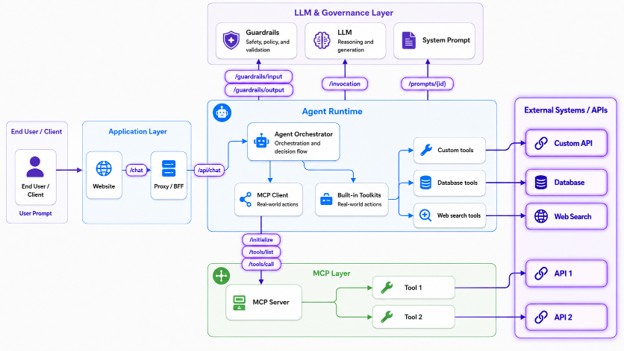
When we map out an agentic application, the risk becomes much easier to see. An agent is not just a chatbot with a better interface. It is a system that can reason, choose tools, and act across real business infrastructure.
The Ingress
Everything starts with the end user.
A user prompt travels through the application layer, usually through a website, product interface, proxy, or backend-for-frontend service. From there, it reaches the agent runtime through a dedicated endpoint such as /api/chat.
At this stage, the request may look simple. A user might ask the agent to summarize an account, update a ticket, pull customer data, search documentation, or trigger a workflow. But once the request enters the agent runtime, the system begins deciding what needs to happen next.
The Brain: LLM and Governance
Inside the agent runtime, the agent orchestrator manages the decision flow. It sends requests to the LLM for reasoning and generation. It also receives instructions from the system prompt, applies policies, and routes input and output through guardrails.
This layer is important because it shapes how the agent thinks and responds. It can help detect prompt injection, block unsafe content, and enforce basic policy rules.
But this layer is not enough on its own.
The model may decide what should happen, but the real risk appears when the agent is allowed to do something. That is where the architecture moves from reasoning to action.
The Action Layer: Where Risk Becomes Real
This is the most important layer for security teams to understand.
Agents become powerful because they can use tools. They can query databases, search the web, call internal services, update records, create tickets, send messages, or trigger automated workflows.
In most enterprise environments, these actions happen through three main pathways.
Built-In Toolkits
Built-in toolkits give agents access to common capabilities such as database queries, web search, file retrieval, or application-specific actions.
These tools make agents useful, but they also create new paths to sensitive data and business-critical operations. If an agent is tricked into using a tool incorrectly, the result may not be a bad answer. It may be a bad action.
Custom Tools
Custom tools connect agents directly to internal APIs and business systems.
This is where many organizations underestimate risk. A custom tool may expose refund workflows, customer records, product data, support actions, or internal admin functions. If the tool has broad permissions, the agent may inherit access that is much wider than the user should have.
These are not theoretical risks. Security researchers have already shown how indirect prompt injection can manipulate AI systems through content hidden in webpages, emails, documents, or other external inputs. The same pattern can apply to agentic tools: a support agent could be pushed into misusing a refund or account-management API, a research agent could be manipulated into exposing sensitive internal data through an overly permissive retrieval tool, and a workflow agent could be guided into triggering a downstream process without enough validation.
The issue is not just whether the prompt was safe. The issue is whether the action was authorized, expected, and visible.
The MCP Layer
The MCP layer is quickly becoming one of the most important parts of the agentic stack.
MCP, or Model Context Protocol, is an emerging way for AI agents to connect with tools, data, and external systems. It gives agents a more standardized way to discover and call tools through MCP servers.
In a typical flow, the agent runtime uses an MCP client to communicate with an MCP server through endpoints such as /initialize, /tools/list, and /tools/call. The MCP server then executes specific tools, which may trigger downstream APIs.
This creates a powerful abstraction layer. It also creates a visibility problem.
A security team may see an API call at the end of the chain, but not understand which agent caused it, which tool was used, which MCP server handled it, or which user prompt started the action.
That missing context is where agentic risk hides.
The API Choke Point: Why Visibility Matters
Once you understand the architecture, one point becomes clear: no matter how complex the agent’s reasoning is, its real-world actions eventually show up as API activity.
The agent may communicate with the LLM, discover tools through MCP, use custom functions, or rely on built-in connectors - all these interactions are API-based as well. Salt provides visibility across this communication layer, not only the final downstream API call. That means security teams can see the broader path an agent takes as it reasons, selects tools, and acts across business systems.
That makes the API layer the natural control point for agentic security.
Security teams do not only need to know that an API was called. They need to understand the full chain behind the call:
- Which agent initiated the action?
- Which user or prompt started the flow?
- Which MCP server or tool was involved?
- Which downstream API was triggered?
- Was the behavior normal, risky, or malicious?
Traditional API logs often cannot answer these questions. They show traffic, but not always the agentic context behind it. That is why API visibility needs to evolve for the agentic era.
Salt Security’s North Star is to secure the full lifecycle of these systems with complete visibility, contextual risk understanding, and real-time protection.
Observability Through the Security Graph
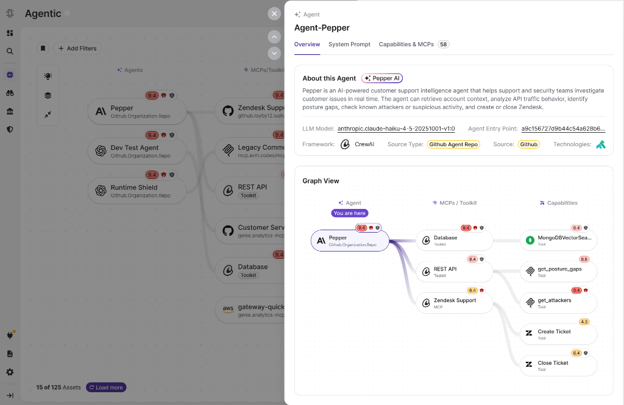
Salt does not treat each API call as an isolated event. It builds a contextual map of the agentic execution chain, including agent-to-LLM communication, agent-to-MCP communication, MCP-to-tool activity, connector usage, and downstream API calls.
This matters because security teams need relationships, not just records.
If a downstream API behaves abnormally, teams need to trace that activity back to the originating agent. If an MCP tool exposes risky actions, teams need to understand which agents can reach it. If an agent communicates with an LLM, calls a connector, invokes a tool, or moves sensitive data through an unexpected path, teams need to see the full route.
That is the value of a unified agentic inventory and security graph. It turns raw activity into an understandable map of risk.
Contextual Posture Management
Agentic systems also need posture management that reflects how they actually operate.
It is not enough to inventory APIs, agents, or tools separately. Security teams need to know how these objects connect, what each one can access, and where the riskiest combinations exist.
For example, an MCP server may not look dangerous on its own. But if it exposes powerful tools to an agent with broad access to sensitive APIs, it becomes a high-priority risk.
Salt expands discovery across the AI ecosystem and brings AI-specific risk models into view. As roadmap capabilities mature, support for frameworks such as OWASP MCP Top 10 and OWASP AI Top 10 can help organizations evaluate risk across agents, MCP objects, tools, and APIs in context.
Real-Time Protection
Visibility is the first step. Protection is the next one.
Because agentic actions ultimately move through the API layer, security teams need the ability to detect risky behavior in real time and, where supported, stop it before it reaches critical systems. That includes capabilities such as tool and API blocking, anomaly detection, and prompt injection detection, with additional roadmap capabilities intended to expand protection across attacker blocking and guardrail-related detections.
This is especially important because agentic attacks may not look like traditional API abuse. The request may come from a trusted agent. The tool may be approved. The API may be legitimate. The risk comes from the combination of prompt, tool choice, permissions, and downstream action.
Salt’s position at the API choke point gives teams a way to monitor and protect the layer where AI intent becomes business impact. Just as important, Salt provides visibility into the broader agent context, including communication with the LLM. Over time, this visibility is expected to expand further into guardrail context as well.
When these API-based signals are connected, security teams can see the full agent architecture in one place: the user request, the agent runtime, the LLM communication, MCP activity, tool usage, connector activity, and downstream API calls. That complete context makes security reasoning much easier. Instead of investigating disconnected events, teams can understand how an agent reached a decision, what it tried to do, and which systems were affected.
Conclusion
The era of agentic security is already here.
AI agents are no longer passive interfaces that only answer questions. They are becoming active participants in enterprise workflows. They call tools, connect to MCP servers, trigger APIs, and act on business data.
That changes the security model.
Building thicker walls around the LLM is not enough. Guardrails are important, but they cannot provide full visibility into what happens after an agent decides to act. To secure agentic systems, organizations need to see the full execution path: from prompt to agent, from agent to LLM, from agent to MCP or tool, and from tool to API. In the future, guardrail context will make that view even richer.
The API layer is where those actions become visible. Combined with LLM communication, MCP context, tool activity, and future guardrail context, it gives security teams the full picture they need to reason about risk and investigate agent behavior with confidence.
Your AI agents are already taking action. Salt helps you see the full path from prompt to LLM, MCP, tools, and APIs, so you can reason about risk with confidence. Request a demo.