

Salt Code · Policy enforcement inside AI coding assistants Stop reviewing
AI code. Start
governing it.
AI is becoming the primary way software gets built, and the APIs, MCP integrations and agent tools it writes are where agentic risk starts. Salt Code enforces your security policies inside every AI coding assistant, with 140+ pre-built policies, so code is compliant by default from the first prompt through runtime.
The problem
AI writes faster than anyone can review.
AI coding assistants generate APIs, MCP integrations, agent tools and application logic faster than security teams can check them. None of them were trained on your internal standards or regulatory requirements.
01 Insecure patterns ship unnoticed
Developers prompt their way to working code. Your policies never enter the conversation, and neither does anyone qualified to enforce them.
02 Security finds issues too late
SAST and DAST catch problems after code is committed and reviewed. Every fix becomes a rewrite, and every rewrite is a delay.
03 Policy enforcement is manual
Your policies live in PDFs, wikis and tribal knowledge. The AI building your software has read none of them.
The shift
Stop reviewing code after it is written. Make it compliant the moment it is created.
How it works
Policy enforcement from prompt to production.
Step 01 Unified governance
Salt Code gives security teams one policy model for how APIs, MCP servers and agents are built, configured and validated in production.
- APIs
- MCP servers
- Agents
Step 02 Discover
Identify what is being built across code repositories and cloud environments, and how it connects, before risk has a chance to hide.
- Code repos
- Cloud environments
- Connections between systems
Step 03 Enforce during generation
Salt turns your security policies into rules that guide AI coding assistants in real time, so output is compliant by default. No developer asks for it, no reviewer chases it.
- Cursor, Copilot, Claude and more
- 140+ pre-built policies
- Custom rules
Step 04 Govern in the pipeline
Policy validations extends into CI/CD and pull requests. Downstream SAST and DAST findings drop because the issues were never written.
- CI/CD workflows
- Pull requests
- Blocked before release
Step 05 Validate in runtime
Monitor behavior across APIs, MCP integrations and agents in production. Detect policy violations, posture gaps and anomalous activity.
- Violations
- Posture gaps
- Anomalous activity
Step 06 Remediate and improve
Findings become actionable fixes in developer workflows and in the assistants themselves, so the baseline quality of AI-generated code improves every cycle.
- Fixes in developer workflows
- Feedback into assistants
- Better baseline each cycle
The product
One console. Every policy. Every assistant.
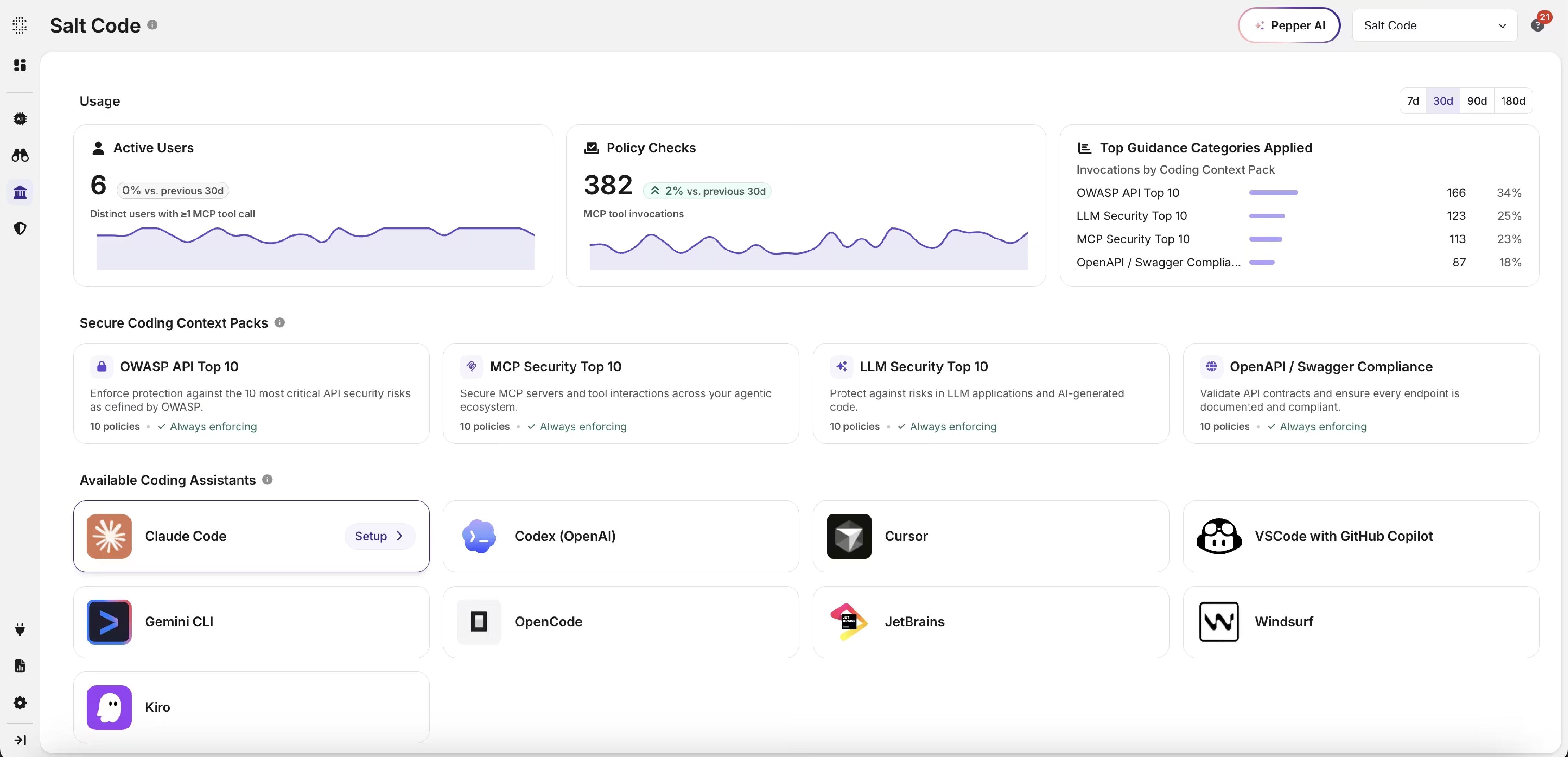
Define policy once. See active developers, policy invocations across MCP tool calls, the top guidance applied and every coding context pack in one place. From OWASP API Top 10 to MCP Security Top 10 to your own custom rules.
Part of the platform
Source code is where agentic risk starts.
Salt gives you breadth across every agent, MCP server and API, and depth across exposure, source code, configuration and runtime behavior. Code is the source code layer, and it closes the loop from code to runtime.
Why it matters
Compliance becomes a property of the code itself.
01 Enforce your policies automatically
Internal standards, industry best practices and regulatory requirements applied to every line of AI-generated code, with no developer effort.
02 Prevent risk at the source
Vulnerabilities never enter your environment. The fastest fix is the one that never had to happen.
03 Cut developer friction and pipeline noise
SAST and DAST findings drop because the issues stopped being created. Developers ship faster.
04 One standard for every developer
Seasoned engineers, citizen developers and overnight agentic prototypes all answer to the same policies.
Use cases
Where your team would use it.
Govern AI-generated APIs and MCP servers
Apply policy to the integrations assistants create, before they reach a repository.
Stop shadow APIs at the pull request
Catch undocumented endpoints and risky integrations in CI/CD, not in production.
Compliant code for every developer
Give citizen developers and agentic workflows the same baseline as senior engineers.
Integrations
Works with every AI coding assistant in your stack.
If it supports MCP, Salt Code governs it. Developers keep the tools they already use.
Make every line of AI-generated code follow your rules.
Salt Code is available now.