


Security teams have never been better at finding problems. Discovery is broader, detection is sharper, and the volume of findings keeps climbing. But a finding is not a fix. When teams identify a risky AI agent, an exposed MCP server, or an active attack against an API, what happens next usually looks the same: someone triages it, someone opens a ticket, and someone on another team eventually makes the change. Until then, the risk stays exactly where it was.
That gap has always existed. What has changed is the cost. AI agents now interact with business systems and take consequential actions continuously, and offensive AI is accelerating how quickly weaknesses are found and exploited. A response process that moves at ticket speed cannot keep up with an attacker that moves at machine speed.
Our own research shows how wide the gap has become. In Salt Security’s State of Agentic AI and API Security 2H 2026 survey of 383 security practitioners, 49.8% reported a confirmed or suspected case of an AI agent taking an unintended action. Only 17.5% said they could automatically stop an agent when something goes wrong.
Earlier this month, Salt Labs' research into the Manus AI agent showed the same pattern from the attacker’s side. A security guardrail flagged the malicious activity, but only after the agent had already run the attacker’s code. (The issue has since been resolved and is no longer exploitable.) Detection worked. It just arrived too late to matter. You can read the full story in When a Security Guardrail Detects the Attack and Still Can’t Stop It.
Today we are announcing Autonomous Defense for the Salt Agentic Security Platform, enabled by an expansion of Salt Workflows. Instead of stopping at an alert or a ticket, Salt can now trigger the defensive controls you already own to block malicious activity, revoke risky access, and initiate remediation across the systems you already use.
What Autonomous Defense does
Using Salt Workflows and connected controls, security teams can act on Salt findings in four ways.
Revoke risky agent and MCP tool access
An agent is only as safe as the tools it can reach. When Salt finds an unauthorized MCP connection, a shadow tool, or an agent holding more privilege than it needs, a workflow can disable the connection, quarantine the tool, or remove the excess privilege through supported management controls.
Block active exploitation
When an attack is in progress, Salt can push targeted blocking rules or virtual protections to the WAFs, API gateways, and other enforcement points already in your environment
Enforce AI and data protections
Salt can update supported guardrail policies, block unsafe requests, or redact sensitive data through connected gateways, so protections keep pace with how AI is actually being used across the business.
Remediate posture gaps
When configuration drifts, a workflow can trigger the changes that close an exposed API, reinstate a rate limit, or restore approved security settings.
How it works: from graph to action
Every action starts with context. The Salt Agentic Security Graph connects AI agents, MCP servers, tools, and downstream APIs, and enriches them with context from exposure, source code, configuration, and runtime behavior. That context is what lets Salt identify the dangerous paths that matter, not just isolated findings, and it informs the policy-driven actions you choose to enforce.

Consider an illustrative example. Salt identifies an AI agent connected to an unapproved MCP tool that can reach a production API. Before, that finding became a ticket in a queue. With Autonomous Defense, a workflow can block the risky traffic at the gateway, revoke the agent’s access to the unapproved tool, route the change for approval if your policy requires it, and record every step in the audit log.
SIEM enrichment, ServiceNow or Jira tickets, notifications, and audit logging all remain available. The difference is that they are no longer the end state. They become steps inside an automated response that actively contains the threat or starts the fix.
Autonomous when appropriate. Controlled when required.
Automation in security only works if teams trust it, so Autonomous Defense is policy driven from end to end. You decide:
- Which findings trigger immediate action
- Which changes require approval before they run
- Which enforcement points are used
High-confidence actions can run at machine speed. Sensitive changes can wait for a human. Either way, every action is preserved in an audit trail.
Built into the platform, connected to your stack
Salt has embedded a visual, drag-and-drop workflow builder directly into the Agentic Security Platform. With 200+ out-of-the-box connectors and a marketplace of Salt-built integrations, teams can design enforcement, governance, and remediation workflows across the tools they already use, without complex custom development.
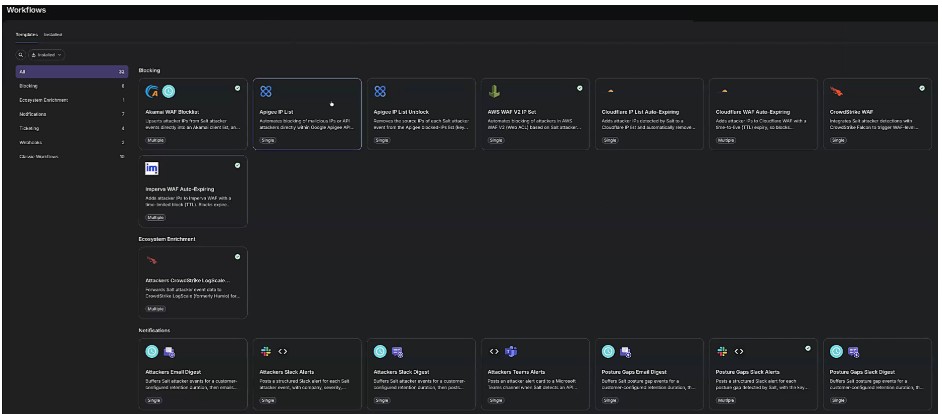
Workflows can span security, infrastructure, IT, and collaboration systems, and they do not require you to standardize on a single gateway, agent framework, or response product.
“Security cannot move at ticket speed when attackers move at machine speed,” said Aner Gelman, VP Product at Salt Security. “Autonomous Defense turns Salt’s security intelligence into action, from blocking malicious activity and revoking risky access to enforcing protections through controls enterprises already use.”
Closing the AI speed gap
Agentic systems act continuously across the business, and attackers are using AI to find and exploit weaknesses faster than ever. Salt combines the Agentic Security Graph, posture intelligence, runtime detection, and automated enforcement so your team can move from identifying a risky path to acting on it in the same operational loop.
“An alert doesn’t stop an attack. Action does,” said Roey Eliyahu, Co-founder and CEO of Salt Security. “Salt secures the entire agentic path, from AI agents and MCPs to downstream APIs. Autonomous Defense puts that intelligence to work, helping security teams stop attacks and close dangerous paths before they cause business impact.”
Availability
Salt Workflows is available to Salt Security customers today. We are migrating existing workflows to the new experience, with support for customer-specific requirements along the way.
Want to see Autonomous Defense in action? Request a demo.
Salt Security is the leader in agentic and API security, securing the entire agentic path from AI-generated code to runtime.